
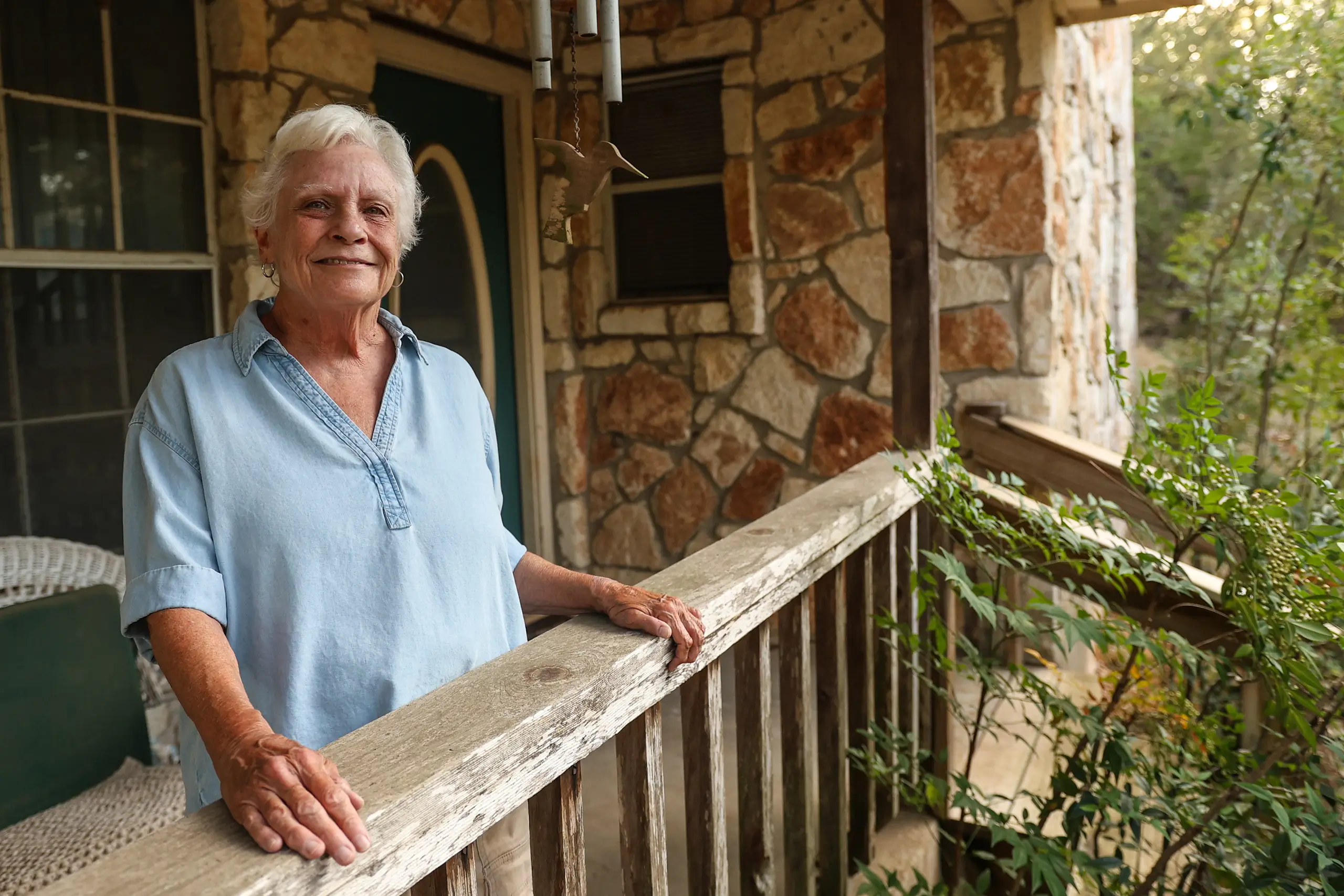
These days, property taxes are just about the only thing Jane Lindsley is saving money on.
For the 72-year-old, the cost of everything — from gas and groceries to homeowners insurance and healthcare — have gone up. So it was a welcome surprise when Lindsley, a retired bookkeeper, received her tax bill last fall to find the property taxes on her home in an unincorporated part of Hays County had shrunk by more than 40%.
Recommended Videos
The chief reason: the amount in school property taxes she owed fell to $0.
“I was ecstatic,” Lindsley said. “I’m like, ‘this is the only thing in my life that’s going down.’ I can actually afford to pay.”
As Texas Republicans vow on the campaign trail to once again wage war on the state’s high property taxes, among the highest in the nation, a clear victor has already emerged: older homeowners. In the wake of additional cuts the Legislature passed last year, some 60% of Texas homeowners age 65 and up no longer pay school property taxes, the largest portion of property owners’ tax bills, according to an analysis by state Sen. Paul Bettencourt’s office.

“People have paid a lifetime of taxes,” Bettencourt, a Houston Republican who authored many of the state’s property tax cuts, said at a Senate committee hearing earlier this month. “When they finally pay zero, and they realize it’s not a mistake, it’s a great day for them.”
In recent years, state lawmakers have sent billions of dollars to school districts to drive down their tax rates, put tight limits on how much cities and counties can raise property taxes without asking voters and boosted tax breaks for homeowners. Now, nearly 2.4 million Texans no longer pay school property taxes.
Lawmakers last year boosted the state’s homestead exemption on school district taxes — or the amount of a homeowner’s primary homestead value that can’t be taxed to pay for public schools — to $140,000. Coupled with a boost in the state’s senior homestead exemption, which also applies to homeowners with qualifying disabilities, homeowners age 65 and up can get $200,000 shaved off their home’s taxable value.
Those efforts resulted in the statewide average school tax bill for general homesteads dropping by 13.6% to $896 last year, according to Bettencourt’s office. For seniors, it fell some 33% to $380. Some 40% of the state’s homeowners no longer pay property taxes, per his office’s estimates.
As Texas voters feel pressure from the rising cost of living, Texas Republicans appear eager to pursue more property tax breaks. Lt. Gov. Dan Patrick said last year he wants to extend the senior homestead exemption on school property taxes to people age 55 and up, while boosting the exemption offered to every homeowner. Meanwhile, Gov. Greg Abbott has proposed eliminating school property taxes for all homeowners, which has sparked fairness questions over who will ultimately be on the hook for Texas property taxes.
Some already see the existing tax-cut scheme as unfair. Younger conservatives, in particular, have argued the state’s tax-cut hawks have focused enough on providing tax relief for older homeowners — as younger folks have struggled to buy homes in Texas — and now should focus on providing relief to other kinds of taxpayers.
“We don’t begrudge older generations for not wanting to be taxed out of their homes,” said Derrick Wilson, chairman of the Texas Young Republican Federation. “But it does seem foundationally unfair to grant tax relief to an older generation that’s been voting for bonds and things that we still have to pay for.”
Tax policy experts on both sides of the aisle agree and view the disproportionate benefit to senior homeowners, who tend to have more wealth than younger generations, as a wealth transfer from younger Texans to older Texans.
That transfer occurs because to pay for school property tax cuts, Texas lawmakers have used surpluses of state revenue funded by other taxes everyone else — including working-age adults struggling to make ends meet — is paying.
“There are a lot of younger people that maybe would need the relief more than those who are retired and have a lot of savings,” said Janelle Fritts, senior policy analyst with the conservative Tax Foundation’s Center for State Tax Policy.
No one whom The Texas Tribune spoke to wants to take away tax breaks for older homeowners, whose fixed incomes and lack of access to affordable housing to downsize has made it harder for them to pay for everyday expenses.
Seniors also wield considerable political influence, giving politicians more impetus to deliver benefits to them. Lawmakers and advocates for older adults have long fretted about the possibility of taxing older adults out of their homes.
But, it’s not clear how much more in tax breaks lawmakers can pay for. Already, state budget watchers have warned that lawmakers’ overall approach to property taxes may be unsustainable amid a slower economy. State lawmakers put $51 billion toward cutting school property taxes last year — an amount they’ve committed to every two years going forward that has made even some Republicans nervous.
The population of older Texans is expected to nearly double in the coming decades, from about 3.9 million in 2020 to 7.5 million in 2050, according to population projections from the Weldon Cooper Center for Public Service at the University of Virginia. As Texas ages, the cost of property tax breaks for older homeowners will grow even faster than breaks all homeowners receive, according to the Texas comptroller’s office.
“Nobody likes taxes,” said Spencer Banzhaf, a professor at North Carolina State University who has studied age-based property tax exemptions. “Anyone would like to get out of their taxes if they can. And I think seniors have been very successful at that in this case.”
The case for older homeowners getting breaks
The cost of virtually everything Lindsley spends money on has gone up.
Her homeowners insurance premium more than doubled because her roof is more than a decade old. She found a cheaper plan, though it was still more expensive than the rate she paid before her previous insurer raised her premium. It’s also gotten more expensive to insure her 2014 Toyota Corolla and to fill up its gas tank, and she now takes fewer errand trips to save on gas. Lindsley stopped buying beef as prices surged, but just one bag of groceries can still add up to more than $100, she said. Her health care costs, too, have grown.
Between Social Security and an annuity, Lindsley brings in about $4,400 a month. She’s able to make ends meet now, but she said she worries costs could eventually grow beyond what she’s able to comfortably afford.
“I just hope it doesn’t get much worse,” said Lindsley, who, despite having no school property tax bill, still paid more than $1,000 in other property taxes on her $546,000 home last year.

Many seniors are on fixed incomes and rely heavily on Social Security, which often doesn’t fully cover the cost of essentials like housing, healthcare, food and transportation. They might have more wealth given higher home values, but that wealth isn’t liquid. And not everyone is able to save for retirement.
More than half of older adults in Texas live below the Elder Index, a calculation by the Gerontology Institute to measure the income older adults need to cover basic expenses.
Of those Texans, 28% are below the federal poverty line, said Caitlin Covey, director of the Center for Social and Demographic Research on Aging at the University of Massachusetts Boston’s Gerontology Institute. The rest are too well off financially to qualify for additional public assistance, but not well off enough to make ends meet.
“They’re making it, but they’re making it in a really fragile set of circumstances,” Covey said.
Many Texas seniors are “cost-burdened,” meaning they spend more than 30% of their income on keeping a roof over their head. Across Texas’ major urban areas, at least 30% of Texans age 65 and up are considered cost-burdened, regardless of whether they own or rent their home, according to Harvard University’s Joint Center for Housing Studies.
Even if they’ve paid off their mortgage, homeowners still face housing costs like utilities, property taxes and insurance. A homeowner in Travis County, for example, who has paid off their home still faces about $904 a month in those kinds of costs, according to the Elder Index.
“Just because you own your home and it looks like you’re wealthy on paper doesn’t mean you have the cash flow to absorb” increases in other costs, Covey said.
In the past, lawmakers have argued they need to target breaks toward older homeowners to help insulate them from rising property values, which can often translate into higher tax bills, as the state has grown. Lawmakers have pitched breaks as a reward for older homeowners who have spent a lifetime paying property taxes.
To some extent, homestead exemptions as a way to cut property taxes will always benefit older people. Homeowners skew wealthier and older, so if the state only offered the general homestead exemption without an additional break for seniors, seniors will still benefit.
In rural areas, that benefit is compounded because of lower property values. Many rural counties are seeing more than three quarters of their senior homeowners no longer paying school property taxes, owing to lower property values, according to Bettencourt’s office. Smaller but still considerable shares of older homeowners in urban and suburban counties no longer pay school property taxes.
“People who have paid property taxes in the same community for 45 years have contributed quite a bit financially,” Covey said. “Some would argue that this is giving them a break that they’ve earned, and not just giving them a break because of their age.”
Are senior tax breaks fair?
Tax policy experts across the political spectrum note that older homeowners tend to be better off financially, and government spending at the federal level is heavily tilted toward helping seniors, so tax breaks are just a further leg up. While many seniors struggle to afford property taxes, many are wealthy enough to afford them, they argued.
“We want folks who have trouble paying their property taxes to get some sort of help,” said Shannon Halbrook, a fiscal policy expert at Every Texan, a left-leaning think tank. “But at the same time, if you can comfortably afford to pay your property taxes, then you should.”
Texas’ property tax-cut regime constitutes a generational wealth transfer because the burden of propping up the property tax cuts falls on younger generations, who are paying state sales tax that then gets passed along to older homeowners in the form of tax cuts, experts said.
More broadly, the state’s tax-cut regime has largely favored homeowners, though lawmakers have also pursued other cuts they argue also benefit businesses and renters. Policy experts fret that renters and business owners will increasingly be on the hook to pay the state’s property taxes.
“If that homestead exemption is so effective, and a lot of homeowners aren’t paying school property taxes, that means that mostly other classes of property are going to be taking up that burden, whether that’s commercial property or that’s renters,” said Fritts, the Tax Foundation analyst.
Bettencourt contests that framing, arguing that everyone pays property taxes, whether they know it or not. The cost of property taxes is baked into the cost of paying rent or a bag of groceries.
Lawmakers’ goal has often been to ensure that older Texans can remain in their homes and aren’t forced to sell and uproot from their community, leaving behind social bonds. But that comes with side effects. Research shows the more in tax cuts a homeowner receives, the less likely they’ll sell that home. That means fewer homes on the market, which drives up overall home prices, making it harder for younger would-be homebuyers to gain a foothold and find a home they can afford.
Meanwhile, seniors might be saddled with a home — and the associated costs — that no longer serves their needs.
Lindsley may sell her home sometime in the next five years, she said. It’s a two-story house with a spiral staircase, and she’s getting older, she said. It might eventually make sense for her to sell and find a one-story house or condominium in the Dallas area, closer to her family, she said.
“I’m thinking about it, but I love that house so much,” Lindsley said.

Policy experts and advocates for older adults argue city officials and state lawmakers need to legalize housing types other than single-family homes on large detached lots and large apartment buildings. That includes making it easier to build more accessory dwelling units, duplexes and smaller apartment buildings that would give seniors downsizing options. Texas lawmakers last year passed laws aimed at allowing more homes to be built, including homes on smaller lots. Abbott wants state lawmakers to make it easier to build accessory dwelling units when they convene next year.
Allowing more housing options would enable family members or caregivers to live closer to their older relatives, said Jessica Lemann, manager of advocacy for AARP Texas.
“There are a lot of people out there that would be happy to downsize, but they still want to stay in their community,” Lemann said. “They may be willing to leave their 2,000, 3,000 square-foot home to go to something smaller, but they don’t want to have to leave their community.”
Potential solutions
If lawmakers want to deliver more in tax breaks to seniors, there are more targeted ways to go about it that don’t depend on payors reaching a certain age, tax policy experts from both sides of the aisle said.
Texas could enact a “circuit breaker” that essentially caps someone’s property tax bill when that bill exceeds a certain percentage of their income, regardless of whether they own or rent. That would ensure that tax relief flows to older homeowners who really need the help while also providing direct relief for older Texans who rent, something Texas’ current tax-cut approach doesn’t do.
State legislators have occasionally flirted with the idea, but abandoned it because Texas doesn’t have a way to administer the benefit — chiefly an income tax, which is used in other states that have such programs to verify a person’s income and deliver the benefit. However, some states like Washington and New Hampshire don’t have an income tax but still provide “circuit breaker” tax programs.
Texas lawmakers have argued that renters benefit from lower school tax rates made possible by $38 billion in state spending to drive down local tax rates, but it’s unclear just how much landlords pass off those benefits to renters.
“If you want to really focus on the folks who need tax relief the most, I think using income is a very appropriate way to do that,” Halbrook said.
As part of his reelection platform, Abbott has proposed getting rid of school property taxes for all homeowners. Some young conservatives, including Wilson, see that as a way to get rid of gaps between younger and older homeowners. But doing so would be highly expensive, detractors have noted, and would likely require the lawmakers to raise the state sales tax rate to pay for it. And under Abbott’s plan owners of other property like apartments, stores, factories and warehouses would still have to pay school property taxes.
In the meantime, homeowners aren’t going to turn down a tax cut. But some acknowledge how important their share can be to paying for services.
Steven Klinek, a Pharr homeowner, turned 65 in June and hopes to see savings on his tax bill he can use to pay for groceries and other expenses.
But Klinek, who retired from United Parcel Service in 2020, said he’s never minded paying property taxes even as his tax bill rose in previous years. Klinek cites the fact that his youngest son earned two years of college credit through the local district’s dual-credit program with South Texas College, partially funded by property taxes. That saved Klinek substantial tuition costs for his son, who’s now a senior at the University of Texas at El Paso owing to the program.
“I see what my community does with their tax dollars,” Klinek said. “I see it on paper, I see it in my pocketbook, and I see what happens to kids. So that’s why I don’t have a problem paying my property taxes.”
Disclosure: AARP Texas has been a major financial supporter of The Texas Tribune. Every Texan has been a financial supporter within the past five years. The Texas Tribune is a nonprofit, nonpartisan news organization that is funded in part by donations from members, foundations and corporate sponsors. Financial supporters play no role in our journalism. Find a complete list of them and more information about our financial and disclosure policies here.